We need your help now

Support from readers like you keeps The Journal open.

You are visiting us because we have something you value. Independent, unbiased news that tells the truth. Advertising revenue goes some way to support our mission, but this year it has not been enough.

If you've seen value in our reporting, please contribute what you can, so we can continue to produce accurate and meaningful journalism. For everyone who needs it.


From Prada to Zara, we checked whether fashion firms keep their green promises

Are luxury brands doing any better than high street fashion? We did a deep dive on who follows through on their pledges.

GREEN CLAIMS SELL clothes – no question.

But unlike other products such as cars and household appliances, fashion remains something of a wild west of self-regulation when it comes to the environment. For jeans and t-shirts, there’s no equivalent of vehicle emissions bands, appliance energy and water usage labels, or plastic bottle deposit return schemes.

Within this regulatory vacuum, many fashion companies have set their own targets and commitments – particularly since 2013.

That was the year of the Rana Plaza disaster, in which a Bangladeshi factory supplying a host of well-known western brands collapsed, killing 1,134 people. Rana Plaza heightened scrutiny of the true cost of cheap clothes, and increased pressure on firms to prove their ethical credentials.

Now reporters from The Journal Investigates and the European Data Journalism Network have evaluated 468 sustainability commitments from more than 200 corporate reports by 17 of the biggest European fashion companies, in a project led by German outlet DW.

From lowering emissions to upping the use of recycled materials, these are the headline pledges from which trickle down the consumer-facing claims and reassurances that retailers hope will make clicking ‘add to cart’ that bit more likely.

The companies we examined included luxury names such as Armani, Chanel, Hermès and LVMH (the conglomerate behind brands including Louis Vuitton, Christian Dior and Givenchy) as well as sports brands Puma and Adidas, and high street giants including Primark, H&M, Mango and Inditex, parent company of Zara and Bershka among others.

Here’s what we found.

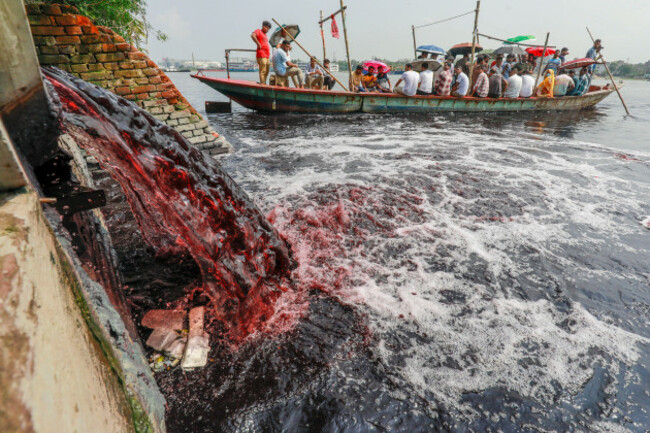
june-1-2024-dhaka-bangladesh-chemical-waste-from-factories-flows-unhindered-into-the-buriganga-river-in-dhaka-bangladesh-june-1-2024-dyeing-factories-in-the-capitals-shampur-area-continued-t Pollution from dyeing factories flows into the Buriganga River in Dhaka, Bangladesh last year. Alamy Stock Photo Alamy Stock Photo

Investigations like this don’t happen without your support… Impactful investigative reporting is powered by people like you.

Are luxury brands doing better than fast fashion?

Confused consumers trying to make more sustainable choices may assume designer and luxury firms are doing more on sustainability than affordable high street brands. 

In fact, that’s not what our analysis indicated.

The eight luxury goods companies we analysed only accounted for about a third of the 468 total stated targets we identified. Swedish multinational H&M had the most commitments, at 70, followed by Adidas with 45 and Puma with 43.

H&M and Adidas also stand out for setting their first sustainability pledges in the early 2000s, over a decade before many other firms.

Luxury brands were also less likely to answer questions about their sustainability programmes: Chanel, Hermès, LVMH, Prada and others did not respond to our queries. An umbrella organisation to which several of the luxury brands belong also did not respond to request for comment.

This lack of transparency came as no surprise to Rachel Kitchin, a campaigner with environmental NGO Stand.earth, which publishes the Fossil Free Fashion Scorecard every two years to rate companies’ commitments and actions on cutting carbon emissions in their supply chains.

By comparison with many mid-market brands, luxury companies tend to be “very quiet”, Kitchin said.

“If they’re doing anything, they’re not telling anyone.

We suspect that’s because they share a lot of suppliers with non-luxury brands, and they don’t want people to know that.”

That said, when we rated companies’ pledges in terms of how meaningful they were, we found that some luxury companies performed better.

Corporate sustainability reports tend to be quite wordy, and we excluded any really vague claims from our analysis – but even of those that remained, some pledges left companies far more wiggle room than others.

The least specific pledges left room for interpretation, while the most concrete were clearly defined, using externally validated indicators and transparent definitions – these were claims to which firms can be held to account.

Armani, for example, has set just 15 pledges since 2018, of which 11 were really specific, including commitments to eliminate single-use plastic from consumer packaging by 2025, and to slash greenhouse gas emissions from its direct operations and its supply chain by 50% and 42%, respectively, by the end of the decade.

By contrast, we identified far more pledges by Puma – 43 in total – but just four-in-10 of these were really specific. Others, such as a 2021 commitment to “set up or join take-back schemes” for old sportswear in “major markets”, were a bit woollier. What’s a major market? What will these take-back schemes involve? What volume of old clothes will be collected, and what will happen to them? The company left itself plenty of room for manoeuvre here – although other pledges it set were more specific.

Puma told us it’s committed to reporting in detail on its targets and how it will achieve them. It added that its sustainability reporting has received positive reviews from independent organisations such as Carbon Disclosure Project.

Kitchin, of the NGO Stand.earth, said ambiguous promises are par for the course in fashion.

“If there is a target, but no information on how they will meet that target, then we consider that to be a flag for greenwashing,” she said.

Even pledges that are specific are not necessarily ambitious or urgent. Inditex, parent company of Zara, made a very specific promise two years ago to phase out the use of highly polluting coal in its supply chain – but not until 2030.

However, Inditex also set a target last year to cut greenhouse gas emissions by over 20% by 2027, relative to 2018. In addition, it made a concrete pledge in 2020 to cut water consumption in its supply chain by 25% by 2025.

Do companies keep their promises?

About half the targets we identified were for a future date, but of the rest, only about half were achieved, with a third failed and the rest unclear.

Online retailer Zalando came out worst when it came to failing its own commitments, with 10 of 17 targets not met.

For instance, Zalando promised in 2021 that by 2023, it would use 100% sustainable cotton (that’s cotton that’s organic, recycled or sourced through the Better Cotton Initiative) for its own-label clothes. It also committed to using 100% responsibly sourced animal fibres, such as those that meet the Responsible Wool Standard or Responsible Down Standard, and at least 50% recycled polyester. None of these pledges were met.

In fairness to Zalando, however, these pledges were very specific – and it reported honestly on its progress. Zalando told us it’s “fundamentally committed to transparency and accountability” in its sustainability reporting – including on where it falls short, and on what it has learned. It said sharing these lessons can support progress across the industry.

Some firms have a tendency to leave it unclear in their corporate reporting whether previous pledges are achieved, or fail.

Mango and Primark were among the companies we looked at which left a large share of their targets unclear, dropping and changing parameters over time.

Primark told us some older commitments it made on phasing out or banning certain chemicals had “evolved” as part of its involvement with a foundation that promotes joint industry action in this area. Work on some other older commitments was “ongoing”, or else “revised and consolidated” when the company published its current, comprehensive sustainability strategy in 2021. Mango did not respond to a request for comment. 

Luxury firms Prada and Moncler performed best on achieving targets – albeit they had set relatively few.

And although Prada achieved five of six targets, some of these were arguably not that important in the grand scheme of things.

For example, it fulfilled a pledge to replace diesel vehicles with hybrid and electric ones. However, as is typical for fashion firms, 96% of Prada’s emissions are in its supply chain, in the production of fibres, fabrics and garments: changing vehicles will have had a miniscule impact on the company’s total carbon footprint.

H&M, which topped the table for setting the most targets, achieved 47%, failed 40% and left the rest unclear. Many of H&M’s targets related to materials. It achieved a goal of using only certified down by 2016, but failed to use 100% Responsible Wool Standard-certified wool by 2022. Instead, it pushed its wool target out to 2025; by 2023 it was two thirds of the way there.

Is self-regulation working?

The thing about self-regulation is that it allows companies to pick and choose what to focus on and what to ignore.

Nowhere is that more apparent than when it comes to fashion’s primary production material: plastic.

Polyester, a form of plastic, is now the most widely produced fibre in the world, accounting for 59% of fibre production last year, according to research by the NGO Textile Exchange. This cheap, fossil fuel-based material has enabled the explosive growth of fast fashion.

Our analysis found companies plan to use more recycled polyester, but they’re not particularly interested in weaning themselves off polyester itself.

The problem is that “recycled” polyester overwhelmingly does not come from old clothes but rather from plastic bottles. Unlike a plastic bottle that can easily be recycled into another plastic bottle, polyester clothes are ultimately destined for incineration or landfill; fabric recycling technology is still in its infancy. Polyester clothing fibres, released during washing, are also a very significant source of microplastic discharges that ultimately end up in the ocean.

The word “recycled” sounds good though, so this is a claim companies like to make.

Adidas has gone further than most, setting a target in 2017 for 100% of its polyester to be recycled by 2024, which it only narrowly failed to achieve. H&M and Mango are also aiming for 100% polyester by 2025. Zalando and Puma also have goals when it comes to recycled polyester. Even Prada is counting recycled polyester as a “lower impact material” and is aiming to increase the amount it uses.

Ursa Trunk, a campaigner with the environmental NGO Changing Markets, said these promises are little more than a smokescreen for companies’ reliance on materials made from fossil fuels.

“Once you make a shirt or a skirt out of the bottle, it can never be recycled again,” Trunk said.

Adidas was alone among the companies we looked at in setting a specific target to increase the amount of polyester it uses from recycled textile waste – although its goal is just 10% by 2030.

Ultimately, voluntary action can only get the fashion industry so far, according to Jules Lennon, retail strategy lead at the Ellen MacArthur Foundation. The foundation works with fashion companies to promote renewable materials and durable and recyclable products.

While Lennon sees voluntary action by businesses as “absolutely essential”, the foundation’s work over the past eight years has led her to the conclusion that this has to be bolstered by ambitious policy.

At this moment, European policy in this area hangs in the balance. A Corporate Sustainability Reporting Directive came into force in 2024, requiring firms to disclose information about their resource use, climate impacts and sustainability actions – but the European Commission postponed these measures earlier this year, and exempted many companies from the requirements.

Negotiations on a Green Claims Directive to crack down on greenwashing are on hold after pushback from the centre-right European People’s Party, of which Fine Gael is a member, on the basis that the proposal represents anti-competitive red tape.

However, the scale of the environmental impact of the fashion sector means there’s no question that action will be needed.

H&M’s greenhouse gas emissions totalled 8.8 million tonnes of CO2 last year (after increasing year-on-year). Primark’s emissions stand at 6 million tonnes of CO2. For comparison, that’s more than the emissions from heating every home in Ireland last year. 

In an experiment this year, the ESRI [Economic and Social Research Institute] randomised 1,200 Irish people into groups and sent them shopping from fake online stores. Some shoppers were shown eco-labels applied to greener garments: these participants made far more sustainable choices than the control group that did not have this information.

The researchers came away with three key findings, explained the ESRI’s Shane Timmons.

Firstly, there’s a real consumer appetite out there for better information on the environmental impact of our clothing choices.

Secondly, we are pretty terrible at estimating how comparatively sustainable different brands are on our own.

Thirdly, consumers tend to underestimate the impact of fashion in general on the environment: we assume other sectors, such as waste, are a bigger contributor to emissions than clothes. The reality is that the fashion industry causes an estimated 2% of global greenhouse gas emission – that’s almost as much as aviation.

Every new garment we buy that we don’t need is contributing to the problem.

The Journal Investigates

Reporters: Valerie Flynn and Kira Schacht • Additional reporting by Ana Muñoz Padrós • Editors: Noel Baker, Milan Gagnon and Gianna Grün • Social Media: Cliodhna Travers • Video: Nicky Ryan • Main Image Design: Lorcan O’Reilly

This project is a collaboration among several media outlets in the European Data Journalism Network (EDJNet) in context of Chat Europe. Project lead: DW. Contributing partners: El Orden Mundial, FACTA, The Journal Investigates and Voxeurop.

All portrayed companies were contacted for comment ahead of publication and asked for clarification on any pledges labeled unclear. Any replies are logged in our database. Amendments were made before publication where necessary.

For data and methodology behind this analysis, see this GitHub repository

Investigations like this don’t happen without your support...
Impactful investigative reporting is powered by people like you. Over 5,000 readers have already supported our mission with a monthly or one-off payment. Join them here:

Close
11 Comments
This is YOUR comments community. Stay civil, stay constructive, stay on topic. Please familiarise yourself with our comments policy here before taking part.
Leave a Comment
    Submit a report
    Please help us understand how this comment violates our community guidelines.
    Thank you for the feedback
    Your feedback has been sent to our team for review.

    Leave a commentcancel

     
    JournalTv
    News in 60 seconds